
Readiness, Scale & Investment Plan
Building the operating layer that lets businesses plan, publish and improve their marketing—then buy expert execution only when they need it.
Prepared 20 September 2026 · Six-month capital plan · Powered by ZeusInfinity Services
Confidential investor material. Please do not forward outside the intended review group without approval.

Krrya turns AI-made content into completed marketing work
The category is crowded with creation and scheduling tools. The investable opportunity is narrower: serve owner-led businesses that want consistent execution, cannot justify a full agency retainer, and still need a human team when AI is not enough.
Free builds the habit. Execution creates the revenue.
Krrya gives a business a useful operating baseline—eight monthly content sets adapted for Facebook, Instagram, Google Business Profile and a website SEO article. The business can prove the workflow first, then buy creative production, editing, specialist services or full management inside the same system.
Capital is not funding an idea. It is funding production hardening, activation, fulfilment operations and evidence of repeatable economics around an existing product.
Marketing is essential to growth—but every renewal must earn its place
The permanent business need
- A local clinic needs discovery and trust.
- A realtor or contractor needs a steady pipeline.
- A startup needs demand before scale.
- A manufacturer needs authority, distributor interest and qualified enquiries.
- An enterprise needs continuous brand, demand and customer communication.
The constraint Krrya is built around
Unlike regulated security or compliance expenditure, marketing can be paused, reduced or redirected. It is therefore judged repeatedly on visible output, learning and commercial outcomes.
Gartner’s 2025 enterprise-weighted survey placed marketing budgets at 7.7% of revenue; 59% of CMOs still said the budget was insufficient. Intuit’s U.S. SMB study found 92% planned to maintain or increase advertising, but those buyers still need confidence that spend is working.
Connect owned channels and establish a consistent publishing habit.
Preview, approve, schedule and monitor real destination outcomes.
The owner sees where time, creative skill or specialist execution is missing.
Buy Assist or Managed delivery only after the workflow has demonstrated utility.
Sources: Gartner 2025 CMO Spend Survey; Intuit 2025 Small Business Advertising Trends. Gartner’s sample was predominantly companies above $1B revenue; Intuit surveyed 1,006 U.S. owners and marketing leaders. Neither benchmark should be transferred directly to Indian micro-businesses.
Some categories ask for commitment first. Marketing must prove itself first.
The useful distinction is not physical versus software. It is how much uncertainty a buyer carries before purchase—and how reversible the decision feels.
Commit first
Specifications, urgency, regulation, ownership or brand trust let the buyer commit before experiencing the full value.
Risk reducer: known specification, strong brand, warranty, regulation, reviews or unavoidable need.
Prove first
Fit, behaviour change and outcomes are uncertain until the buyer uses the system. A large upfront commitment creates resistance.
Krrya’s move: remove the first commitment, demonstrate recurring utility, then charge when the user asks for deeper execution.
Launch phase
Krrya is a new brand and marketing is an outcome-uncertain purchase. “Prove first” is the efficient route to trust and habit.
Brand maturity
As reliability, cases and reputation accumulate, evaluation time can shrink and more buyers may commit earlier—but the category will remain outcome-sensitive.
Large business bases, large spend pools—and a fragmented service layer
India business base official records
96.15MUdyam + Udyam Assist formalisation records as of 19 September 2026. The stricter Udyam count is 53.55M; Small and Medium classifications together are about 585,000.
United States small businesses SBA 2026
36.21M29.81M nonemployer and 6.40M small employer firms, plus 21,041 large businesses. Small businesses represent 99.9% of U.S. businesses.
India advertising spend, 2025 dentsu
₹1.21T₹1,21,339 crore total AdEx; ₹71,621 crore digital. Digital represented 59% and was reported growing faster than the overall market.
U.S. internet advertising, 2025 IAB/PwC
$294.6BUp 13.9% year on year. This is publisher/platform digital-ad revenue—not total marketing services expenditure.
Corporate and formal-business signal
India reported 2.17M active companies and 522,657 active LLPs as of 31 July 2026. These are more relevant to paid business software than treating every informal micro-enterprise record as an immediately serviceable buyer.
Agency supply is large but imperfectly counted
India’s Udyam analysis listed 21,299 advertising registrations—a formal MSME floor. The U.S. Census counted 15,512 employer advertising-agency establishments and 38,864 across advertising, PR and related services. Freelancers and many digital specialists are excluded.
Sources: MSME Dashboard; Ministry of Corporate Affairs; SBA 2026 FAQ; dentsu India 2026; IAB/PwC 2025; Udyam Registration Data Bulletin; U.S. Census 5418 profile.
AI makes content cheaper. It does not make attention or execution abundant.
Generative AI compresses the cost and time required to produce a first draft. That increases content supply—and shifts economic value toward the work that still remains scarce.
Why free is possible
The user supplies the generative-AI subscription and free-plan media storage. Krrya carries orchestration and publishing, so the marginal technical cost of proving value can remain low.
Why free is not the business
As output becomes cheaper, owners still pay for creative quality, editing, specialist decisions, campaign execution, optimisation and someone accountable for completion.
Bring business context and connect owned channels.
Approve and schedule the first real content item.
Return to the calendar and publishing rhythm.
A post exposes a creative, editing or specialist gap.
Attach Assist or move to Managed execution.
Eight content sets make Krrya useful before the first purchase
The free offer is a behaviour engine. It should create a recurring planning-and-publishing habit while exposing the exact moments when expert help has value.
The user adds their brand, offers, audience and operating context.
The user can work through their own ChatGPT and the guided Krrya connection.
Each theme is adapted for Facebook, Instagram, GBP and a website SEO article.
Calendar, preview, approval, publishing state and mobile visibility remain in one place.
Self
Businesses use Krrya with their own AI and storage. Krrya becomes the planning, preview, approval and publishing workflow at low marginal software cost.
Assist
When a content item needs a graphic, carousel, video edit or specialist task, the user attaches a defined human deliverable exactly where the work is needed.
Managed
Businesses move into ongoing social, GBP, SEO, performance or 360-degree execution without leaving the operating system they already use.
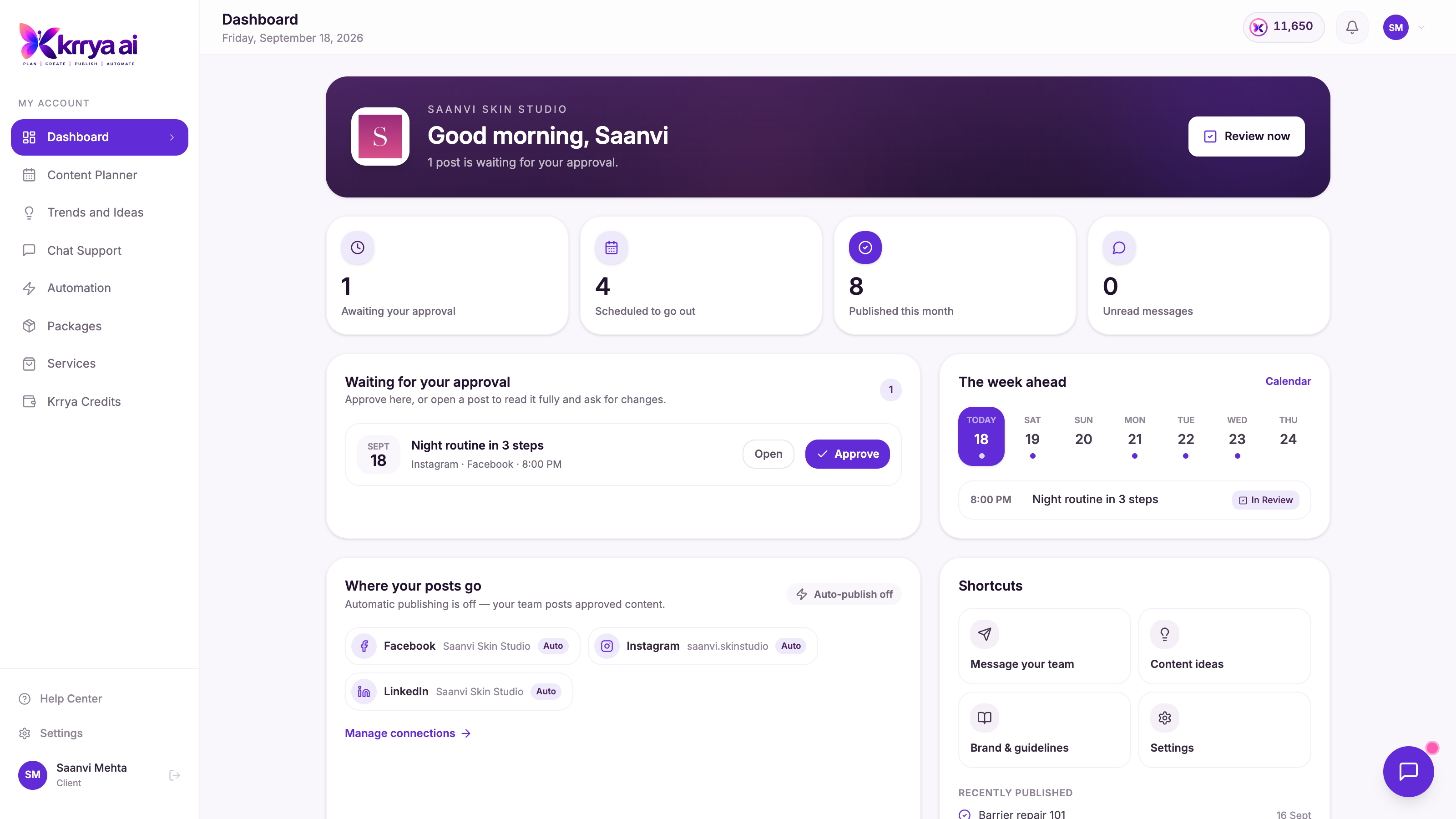
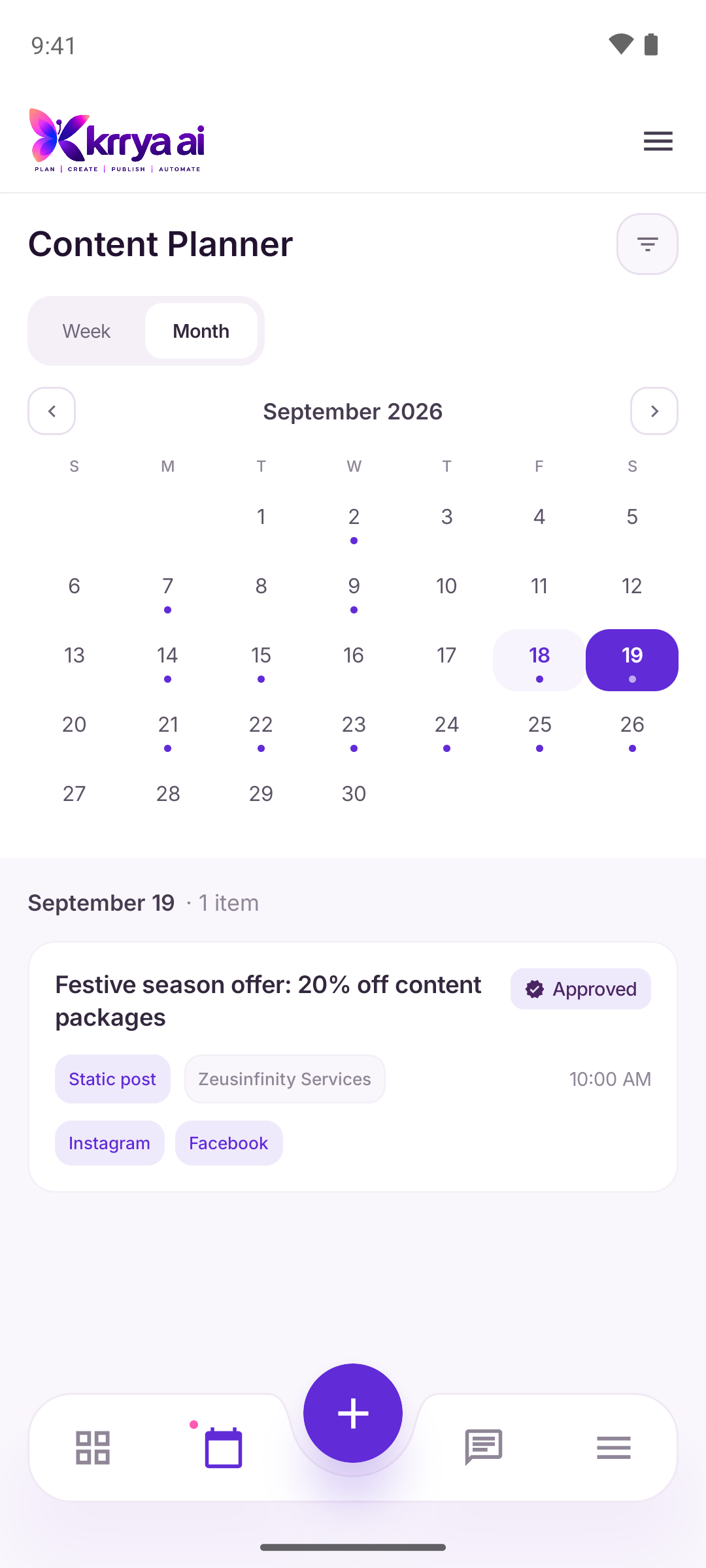
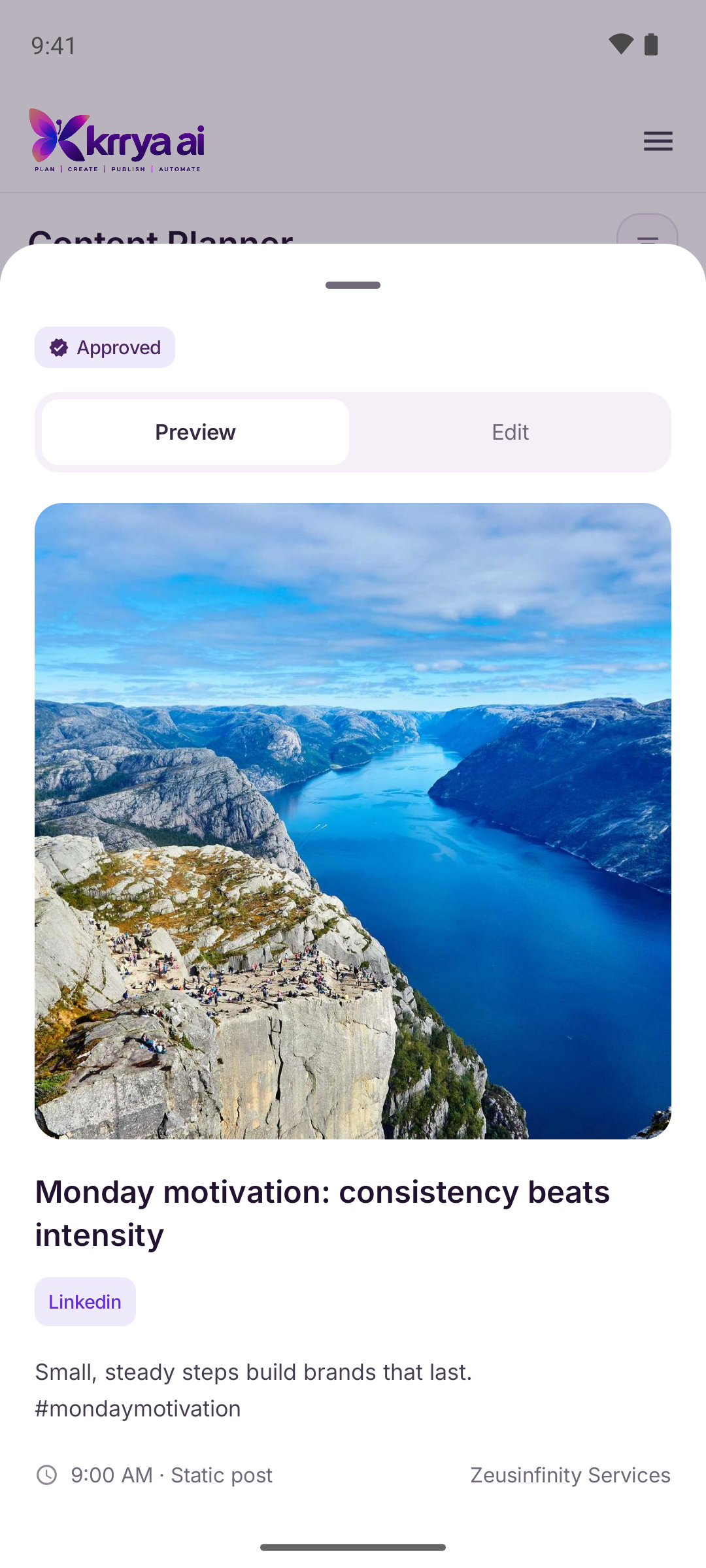
The operating workflow is visible across desktop and mobile
Plan
Calendar views, ideas, industry news and trends connect discovery to a dated plan.
Control
Preview, edit, approve and review status before content reaches a destination.
Monetise
Services, credits, orders and transaction history are already represented in the product experience.
Actual Krrya product snapshots supplied in the product workspace. Screens illustrate implemented/near-ready UI; production reliability is governed by the release gates later in this document.
AI, MCP, mobile and scheduling are no longer a moat
Strong features—but increasingly expected
- External ChatGPT / MCP operation
- AI captions, ideas and creative support
- Calendars, approvals and previews
- Mobile access and analytics
- Multi-channel publishing and OAuth
- Hosted build-and-launch platforms such as Floot
The position Krrya can credibly own
- Human fulfilment attached to the exact content item
- One path from Self → Assist → Managed
- Bring-your-own-AI economics instead of forcing bundled generation
- Social + GBP + website/SEO execution in one relationship
- Defined specialist services without a traditional agency retainer
- Customer control with one accountable operating layer
Where Krrya is ahead
Workflow-to-service continuity and broad marketing execution are structurally uncommon among scheduler-led competitors.
Where incumbents are ahead
Publishing maturity, integrations, analytics depth, listening, collaboration and proven reliability.
What decides success
Activation, publication reliability, fulfilment quality, contribution margin and distribution—not feature count.
Examples of the converging category: Buffer MCP; Hootsuite MCP; Planable MCP; ZocialOne MCP; Metricool MCP; Floot for AI-led app/website building, hosting and MCP-style build workflows.
Competitor ratings against the workflow Krrya intends to win
Scores measure fit with Krrya’s chosen strategy, not overall product quality. Publishing leaders score higher on maturity; Krrya scores higher where software, user-owned AI and human execution meet.
| Product | Publish 15% | Plan & approve 10% | Analytics 10% | AI/MCP 10% | Own-AI economics 10% | Experts in workflow 20% | Self→managed 15% | Social+GBP +web 10% | Fit /10 |
|---|---|---|---|---|---|---|---|---|---|
| Krrya AI | 6.8 | 8.5 | 6.5 | 8.8 | 10.0 | 9.5 | 10.0 | 9.5 | 8.75 |
| Leadmetrics | 6.5 | 7.0 | 8.5 | 2.0 | 4.0 | 8.5 | 8.0 | 9.5 | 6.98 |
| Hootsuite | 9.6 | 9.4 | 9.4 | 10.0 | 7.0 | 1.0 | 2.0 | 5.0 | 6.02 |
| Agorapulse | 9.3 | 9.6 | 9.4 | 9.0 | 7.0 | 1.0 | 2.0 | 5.0 | 5.90 |
| Metricool | 9.2 | 8.5 | 9.8 | 9.0 | 7.0 | 1.0 | 2.0 | 5.0 | 5.81 |
| Planable | 9.0 | 9.8 | 8.5 | 9.0 | 7.0 | 1.0 | 2.0 | 5.0 | 5.78 |
| Buffer | 8.8 | 8.5 | 8.0 | 9.5 | 8.0 | 1.0 | 2.0 | 5.0 | 5.72 |
| SocialPilot | 9.2 | 9.4 | 8.4 | 8.5 | 6.0 | 1.0 | 2.0 | 4.5 | 5.56 |
| ZocialOne | 8.0 | 8.0 | 8.0 | 9.5 | 4.0 | 2.0 | 3.0 | 5.0 | 5.50 |
| Ocoya | 8.3 | 8.2 | 7.5 | 9.5 | 4.0 | 1.0 | 2.0 | 7.0 | 5.37 |
| Sprout Social | 9.3 | 9.4 | 9.8 | 6.0 | 4.0 | 1.0 | 2.0 | 5.0 | 5.32 |
| Later | 9.4 | 8.7 | 8.6 | 4.0 | 4.0 | 1.0 | 2.0 | 3.0 | 4.74 |
| Turrboo | 8.0 | 8.0 | 8.0 | 2.0 | 4.0 | 1.0 | 2.0 | 4.0 | 4.30 |
Why Krrya does not score 10
Its publishing and analytics ratings are deliberately below mature incumbents. The product must still prove production reliability, mobile parity, scale and measured customer outcomes.
Why the fit score is still high
Thirty-five percent of the score is tied to embedded experts and the Self→Assist→Managed continuum—the core business-model distinction Krrya is choosing to build.
Evidence-led assessment, September 2026. Public product/pricing pages reviewed for ZocialOne, Metricool, Planable, Turrboo, Ocoya, Leadmetrics, Buffer, Hootsuite, Sprout Social, Later, SocialPilot, Agorapulse and Floot as an adjacent MCP/app-building benchmark. Ratings are strategic-fit judgements and should be validated during diligence.
Krrya’s wedge is not just cheaper pricing. It is free proof before services.
Most social tools sell access to scheduling, analytics or collaboration. Floot shows that MCP-led workflows are spreading into build-and-host categories too. Krrya’s sharper investor story is different: make the business habit visible first, then sell execution at the exact moment of need.
| Product | Category | Free entry? | First paid entry | What the entry plan mainly sells | Krrya implication |
|---|---|---|---|---|---|
| Krrya AI | Marketing execution OS | Yes · proposed 1-year free activation | Credits / Assist / Managed | Planning, publishing habit, then human execution | Free proof creates trust before service spend |
| Buffer | Social scheduling | Yes · free forever entry | Approx. $6/channel/mo | More channels, analytics and scheduling scale | Free exists, but no embedded fulfilment layer |
| Metricool | Analytics + scheduling | Yes · one-brand free plan | Starter pricing varies by region | More brands, reporting and analytics | Strong tool depth; less service conversion built into posts |
| Planable | Approval + planning | Yes · first posts free | Basic from about $33/workspace/mo | Team approvals, calendar and collaboration | Excellent approval workflow; not an execution-services marketplace |
| Ocoya | AI social content | Trial, not permanent free | Starter about $29/mo | AI credits, social profiles and content creation | AI content is bundled; Krrya can use customer-owned AI economics |
| Floot | AI app/website builder | Yes · free build actions | Pro about $25/mo + hosting allowance | Build, database, auth and hosting from AI chat | Adjacent threat: MCP + hosting is becoming normal; Krrya must win on marketing execution |
| Enterprise incumbents | Social suites | Mostly trial/demo-led | Often higher subscription or custom pricing | Governance, analytics, listening and support | Krrya should not fight enterprise suites head-on early |
Free plan language
Use “free for the first year” or “founding free year,” not lifetime free. Lifetime free can create support and entitlement risk.
Investor framing
The free wedge is a sampling engine for marketing execution, not a charity plan. It buys activation data, trust and conversion moments.
Competitive lesson
Floot proves MCP-led work is a category pattern. Krrya’s defensibility must come from content-to-service operations and outcomes.
Pricing and free-entry references are public-page snapshots from September 2026 and should be refreshed before external investor diligence or term-sheet circulation.
A broad product exists; the publishing core remains a controlled-beta system
Mass-acquisition release gate
- Per-destination publication status
- Idempotency keys and zero duplicate posts in retry testing
- Bounded retries and dead-letter recovery
- Encrypted tokens, least-privilege scopes and secret rotation
- End-to-end publication matrix across the four free destinations
- Measured restore, monitoring and incident response
Commercial instrumentation
- Activation: connection + first scheduled or published item
- D7/D30 active retention
- Publication success and retry rate by destination
- Support minutes per active free account
- Assist attachment, repeat purchase and managed conversion
- Gross contribution after fulfilment labour
User growth is not fulfilment readiness. The service engine is the next product.
Krrya can surface and accept service demand. To serve thousands reliably, creator capacity, routing, delivery and quality control must operate as one auditable system.
Services, packages and credits exist; production order states still need completion.
Validate brief, SLA, quota and credit reservation before work enters production.
Route by due date, service type, complexity and customer tier—with escalation.
Match skill, capacity, cost, performance and backup availability.
Brief, source files, deadline, communication and version history in one job record.
No direct creator-to-client hand-off; brand, scope and technical checks come first.
Client review, bounded revision loop, notifications and SLA clock.
Close delivery, release credits, record cost, margin and creator performance.
Creator supply layer
The operating network that turns digital demand into dependable output.
By deliverable, skill and quality tier
Availability, SLA and rate cards
QA pass, rework and timeliness
Backup pools, payouts and churn cover
Scale the API and publishing workers independently
Experience
Web + mobile, onboarding, brand context, ideas, calendar, preview, approval, services and credits
Control
API, PostgreSQL, entitlements, OAuth vault, ledger, audit history and destination state
Execution
Queue, platform workers, idempotency, retries, dead letters, rate controls and alerts
Free-plan economics
- Content generation happens in the user’s ChatGPT account.
- Free-user media remains in the user’s Google Drive.
- Krrya pays for orchestration, metadata, logs, notifications and support—not model tokens or permanent free-media storage.
- Standard social/GBP/WordPress publishing is modelled with no per-post API fee; access and rate limits still apply.
Trust architecture
- No social passwords shared with Krrya staff.
- Official OAuth and revocable scopes wherever supported.
- Publishing permission is separate from content approval.
- Every destination attempt has an auditable result.
- Manual destinations remain clearly labelled; calendar support must not be presented as automated publishing.
Technical references: Google Drive API limits/pricing; Google Business Profile API quotas; WordPress Posts REST API; WordPress authentication.
The external API bill is small; reliability and support are the real costs
Monthly technical cost: ₹7,000–₹12,000
| Two small compute roles | ₹3,000 |
| PostgreSQL + backups | ₹2,000–₹4,000 |
| Queue, logs and object overhead | ₹1,000–₹3,000 |
| Monitoring and notifications | ₹1,000–₹2,000 |
| Platform API transaction line | ₹0 assumption |
Monthly operating cost: ₹13,000–₹14,000
Support: 500 active users × 6 minutes ÷ 60 = 50 hours. At the current internal planning cost of ₹250/hour, support costs ₹12,500.
Transactional communication reserve: ₹500–₹1,500 for email/SMS/alert usage, depending on provider and channel.
Blended free-serving cost: approximately ₹20,000–₹26,000/month, or ₹40–₹52 per active user.
Automation lowers unit cost only if support time falls with scale
| Monthly run rate | 500 active | 5,000 active | 50,000 active |
|---|---|---|---|
| Content sets | 4,000 | 40,000 | 400,000 |
| Destination jobs | 16,000 | 160,000 | 1,600,000 |
| External API calls incl. 20% reserve | 96,000 | 960,000 | 9,600,000 |
| Media transfer incl. 25% overhead | ≈60 GB | ≈600 GB | ≈6 TB |
| 12-month DB/log footprint incl. 2.5× headroom | ≈8 GB | ≈78 GB | ≈780 GB |
| Required peak dispatch capacity* | 0.4 jobs/sec | 4 jobs/sec | 36 jobs/sec |
| Infrastructure planning range | ₹7–12k | ₹25–60k | ₹1.1–2.5L |
| Support minutes / active user target | 6.0 | 3.0 | 1.5 |
| Support hours at target | 50 | 250 | 1,250 |
| Blended free-serving cost / active user** | ₹41–51 | ₹19–26 | ₹9–12 |
*Peak model: average daily jobs × 30% concentrated in the busiest 15-minute window × 2 safety factor. **Blended cost: infrastructure + support at ₹250/hour + communication reserve of ₹1k / ₹5k / ₹30k. Excludes content creation and paid services.
Infrastructure is manageable
Even 50,000 active free users is a moderate job-processing workload when publishing is queued and media is not permanently hosted by Krrya.
Support is the danger
If support remains six minutes per active user at 50,000, it becomes 5,000 hours/month—destroying the volume thesis.
The scale gate
Do not buy mass traffic until self-service onboarding, in-product guidance and failure recovery reduce support minutes cohort by cohort.
Monetise moments of need—not access to an empty dashboard
Free · habit
Eight monthly content sets across the four launch destinations, using the customer’s AI and storage. Goal: activation, recurring use and trust.
Assist · transaction
Credits purchase defined human deliverables at the exact post or business task where help is required. Goal: high-frequency service attachment.
Managed · relationship
Social, GBP, SEO, performance and 360-degree programmes for businesses that want ownership transferred to a team. Goal: recurring revenue and deeper outcomes.
Initial route to market
- Beachhead: India-based owner-led service and local businesses where Facebook, Instagram, GBP and website search presence all matter.
- Activation channel: founder-led demos, webinars, existing ZeusInfinity relationships and city campaigns—not broad paid acquisition on day one.
- Conversion trigger: offer expert help after a real content item exposes a creative, editing, website or campaign need.
- International expansion: localised USD pricing and support only after India cohorts prove reliability and contribution margin.
Six-month evidence targets—not revenue promises
- 500 active businesses complete the proof cohort.
- At least 50% assisted and 25% self-serve activation.
- D30 retained-active rate of at least 30%.
- At least 99% controlled publication success; no duplicate posts.
- Support at or below 6 minutes per active user at 500 and 3 minutes at 5,000.
- At least 5% 90-day paid/service conversion or another measured path to positive contribution.
- 5,000 monthly active businesses before large-scale acquisition.
₹60 lakh funds six months of de-risking and measured scale
Dedicated capacity required
Senior platform/backend ownership, full-stack delivery, QA automation, fractional DevOps/SRE, customer activation, fulfilment operations and a performance-growth owner.
What the investor buys down
Platform failure risk, support-cost uncertainty, weak activation, inconsistent service delivery and premature CAC—not speculative feature expansion.
The round is structured to buy proof before pricing scale
The cleanest investor conversation is not “fund a big idea.” It is “fund the six-month proof cycle that makes the next valuation obvious.” Krrya should keep the instrument simple, milestone-aware and flexible enough for angel or strategic investors.
Recommended instrument
Preferred: CCPS / CCD / convertible note style structure, depending on entity setup and investor profile. It keeps the first round practical while allowing the valuation to settle around measured traction.
Alternative: straight equity if the investor wants immediate ownership and both sides agree the valuation range is fair.
Terms to discuss, not overcomplicate
- Round size: ₹60L, with optional extension if strategic demand appears.
- Conversion trigger: next qualified round, milestone date or mutually agreed valuation event.
- Governance: monthly investor update, spend dashboard and milestone review.
- Use restriction: no heavy acquisition spend until the readiness gates pass.
Capital follows proof, not optimism
PostgreSQL migration, queue workers, secrets review, idempotency, retries, destination state and baseline instrumentation.
Controlled publication matrix, restore/load tests, 100-business design cohort and repaired onboarding.
Reach 500 active businesses; measure D30 retention, support minutes, service attachment and fulfilment margin.
Move toward 5,000 active businesses only if reliability and economics hold. Keep 50,000 registrations as stretch, not success by itself.
| Core risk | Stop / review signal | Capital response |
|---|---|---|
| Publishing breaks trust | Controlled success below 99% or any duplicate-post pattern | Pause acquisition; isolate and fix the destination adapter |
| Free creates activity but no habit | D30 retained-active below 30% across two cohorts | Repair use case/onboarding; do not add more free volume |
| Support destroys unit economics | More than 6 min/active at 500 or 3 min at 5,000 | Automate, narrow entitlement or make onboarding paid |
| Services scale revenue but not margin | Repeated negative contribution after fulfilment labour and revisions | Reprice, standardise scope and build creator capacity before growth |
| Position collapses into “another scheduler” | Buyers value only low price or post count | Refocus on embedded execution, cross-channel continuity and proof |
How to present the deck in a live investor conversation
Use the page as a guided conversation, not a document dump. The strongest sequence is: market pain, product wedge, evidence, economics, risk discipline, capital ask.
Marketing is a high-anxiety spend. Buyers want results, but they do not trust agencies, tools or retainers immediately.
Krrya enters through free planning and publishing, then monetises the exact moments where human help is needed.
Use screenshots and product flow to show this is not just an idea or pitch-page concept.
Reliability, support and fulfilment are named openly. This makes the ask feel operationally mature.
₹60L funds a six-month proof cycle. The investor is buying a measured de-risking path, not blind scale.
Suggested 12-minute flow
- One minute: what Krrya does and why marketing needs a try-first motion.
- Two minutes: market size, SMB behaviour and why low-cost AI changes service delivery.
- Two minutes: product proof, supported channels and competitive difference.
- Two minutes: operational readiness and what still needs to be built before scale.
- Two minutes: economics, GTM and scale gates.
- Three minutes: ₹60L ask, terms discussion and investor questions.
Best closing sentence
“We are not asking you to fund mass marketing today. We are asking you to fund the six-month proof that shows whether Krrya can become the operating layer between AI-generated content and completed marketing outcomes.”
Keep ready for diligence
- Product demo access for qualified investors
- Development roadmap and readiness tracker
- Pricing framework and service catalogue
- Founder/company structure and cap table
- Draft term sheet and legal instrument preference
Assumptions, limitations and source register
Management assumptions to replace with cohort data
- Eight monthly themes become 32 destination jobs.
- Five external requests per destination job plus 20% retry/monitoring reserve.
- Average media payload of 3 MB and 25% network overhead.
- 25 KB content metadata and 10 KB retained event/log data per job.
- 2.5× data headroom for indexes, replicas/backups and working space.
- Internal operating labour cost of ₹250/hour.
- Support falls from 6 to 1.5 minutes per active user through self-service and product learning.
- Standard publishing APIs have no material per-call fee at modelled volumes; access, quotas and policies can change.
India business base
MSME Dashboard; Udyam factsheet; MCA active companies/LLPs.
U.S. business base
SBA 2026 Small Business FAQ; Census SUSB.
India advertising
dentsu e4m 2026; ET Brand Equity–Ipsos 2025–26.
U.S. advertising
IAB/PwC Full Year 2025.
Budget behaviour
Gartner 2025 CMO Spend; Intuit SMB Advertising 2025.
Agency counts
Udyam Data Bulletin; Census NAICS 541810; Census NAICS 5418.
Technical policies
Drive API limits; GBP quotas; WordPress REST posts.
Competitive evidence
Official home, feature, integration and pricing pages for the 12 named competitors; detailed links are provided on pages 9–10.
Krrya evidence base
Product documents, supplied screenshots, brand assets, codebase review and September 2026 planning discussions.
Method: market figures were triangulated from government or first-party research wherever available; non-equivalent units are labelled instead of summed. Cost estimates use explicit workload equations and management assumptions. Competitive claims distinguish table-stakes from potentially ownable differentiation.